The people who lived in remote areas such as mountainous regions of Papua are still encountering difficulties to access standardized health facilities. The issue with the lack of the medical workers in Papua becoming a serious problem for the government. This is caused by the absence of protection guarantee for the medical workers that assessed there. It is undeniable that the many cases of attacks on medical personnel and health workers by the Papuan Terrorist Separatist Criminal Group (KSTP) are still the biggest fear for health workers today.
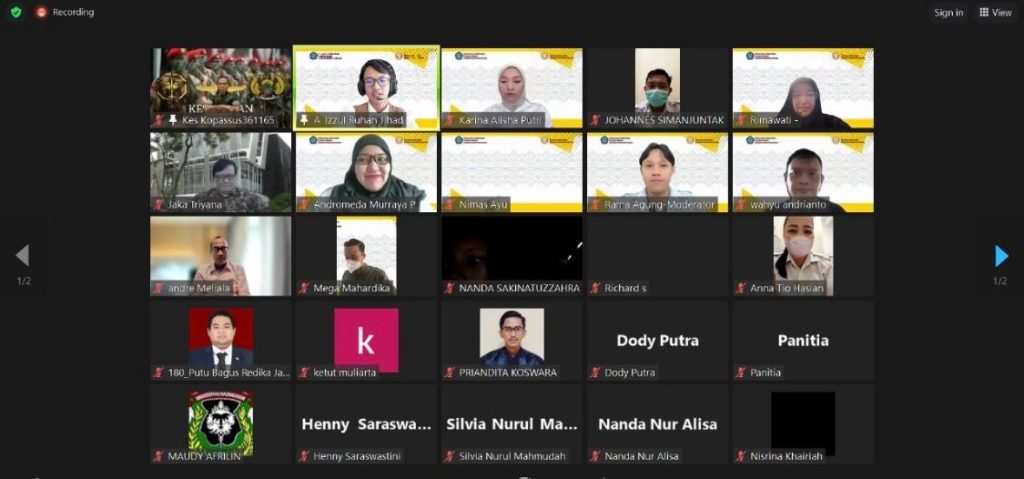
In supporting the 3rd point of UN Sustainable Development Goals SDGs, the Community of Medical Law Master Student of Faculty of Law UGM just held a national seminar entitled, “National Seminar as the Effort in Equal Distribution and Protection of Medical Workers in Conflicted Areas”. The event that was held on Saturday (24/2/2024) virtually was attended by 160 participants.
This National Seminar presented 3 speakers, those are Dr. dr. Andreasta Meliala, DPH., M.Kes., MAS. as the Head of Integrated Health Services UGM, Dr. Heribertus Jaka Triyana, S.H., M.A., L.LM. as the Vice Dean for Community Service Research and Information Systems FH UGM as well as a lecturer in Law and Human Rights, and Lieutenant Colonel of the Military Health Corps (CKM) dr. Oedjang S., M.Si. Med., Sp.B. who currently serves as the Head of Health of the Special Forces Command (KOPASSUS) of the Indonesian National Army (TNI AD) of the Republic of Indonesia.
In this seminar, dr. Andreasta brought the issue in equal distribution of medical workers in conflicted areas and the urgency of derivative regulations from Law No. 17 of 2023 concerning Health. The need for a specific policy and strategy framework that takes into account regional characteristics and also the importance of defining the matrix of conflict areas other than remote areas, borders, and islands. Furthermore, Jaka Triyana explained that there were several human rights violations experienced by medical personnel according to Law No. 39 of 1999 concerning Human Rights, namely violations of the right to life, a sense of security, justice and welfare and including how the advocacy and adjudication processes are carried out in overcoming these problems. Analysis of the human rights situation in emergency situations must be seen from two perspectives, namely the perspective of rights enjoyers and rights holders, and how the basic principles of humanitarian law are in the matter. In the final discussion, Dr. Oedjang invited the nation's young successors, especially young doctors, to be able to serve by providing health services in the Papua region.
The importance of protection for medical personnel and health workers in conflict areas in Indonesia is the first step to realizing the Good Health SDGs Pillar. With sufficient health human resources in Papua, 6 transformations of the Indonesian health system will be achieved. The high maternal mortality rate and infectious disease infections in Papua will be reduced with good handling by medical personnel which is one of the targets in achieving Indonesia's SDGs 2030.
Penulis: Andromeda Murraya Putri
Editor: Public Relations