The question of presidential impeachment has resurfaced in public discourse — largely as a reaction to the controversy surrounding the Constitutional Court's ruling that opened the door for Gibran Rakabuming Raka, a son of the President, to run as a vice-presidential candidate alongside Prabowo Subianto. The latest push for impeachment came from Petisi 100 Penegak Daulat Rakyat a coalition of 100 public figures, who called on the People's Representative Council (DPR) and the People's Consultative Assembly (MPR) to move to impeach President Jokowi on grounds of alleged unconstitutional conduct.
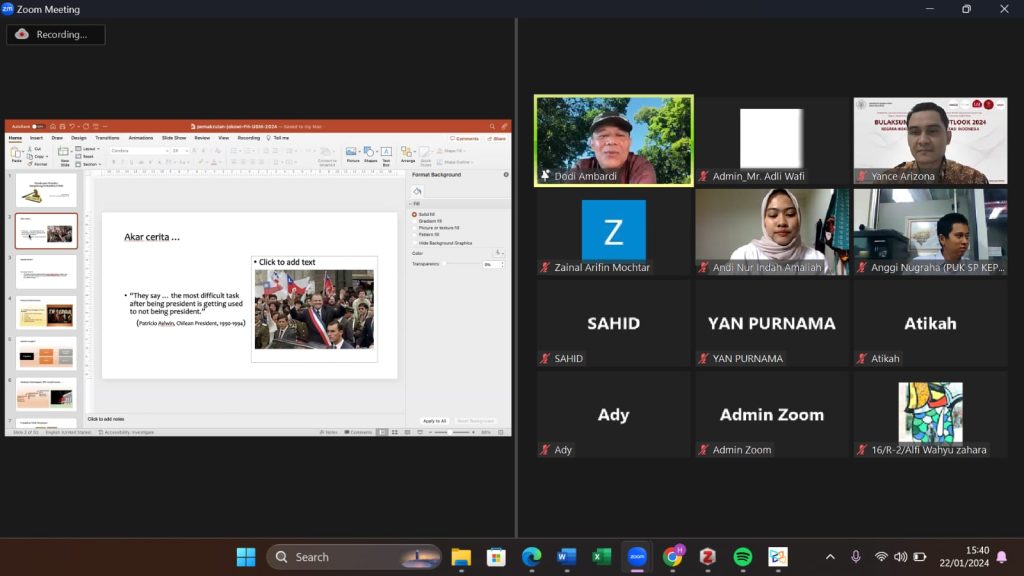
In response to this developing debate, the Centre for Democracy, Constitutional Law, and Human Rights (Pandekha) at the UGM Faculty of Law organized an online discussion on Monday, January 22, 2024, titled "Presidential Impeachment: Is It Permissible? Is It Possible?" The event reflects SDG 16 on Peace, Justice and Strong Institutions. Two speakers participated: Kuskridho Ambardi, Ph.D., lecturer at UGM's Faculty of Social and Political Sciences, and Dr. Zainal Arifin Mochtar, Head of the Department of Constitutional Law at the UGM Faculty of Law. The discussion was opened by Yance Arizona, Chair of Pandekha, and facilitated by Indah Amaliah, a Pandekha volunteer.
The speakers noted that while impeachment is constitutionally possible, it requires specific qualifying grounds. A president may only be impeached for criminal conduct, disgraceful behavior, or administrative violations — and any constitutional violation cited as the basis for impeachment must be explicitly defined in the Constitution, not merely a policy disagreement. From a political standpoint, the DPR is one of the three institutions that hold the impeachment process, making it a key gatekeeper: without a proposal from the DPR, impeachment cannot proceed. Indonesia's impeachment mechanism involves three state institutions — the MPR, DPR, and Constitutional Court (MK) — and the process remains heavily dominated by the legislative branch (the MPR/DPR), reflecting what is known as a legislative dominant or congressional model.
Zainal Arifin Mochtar noted that while impeachment is a constitutional mechanism provided for in the Constitution, its operation depends heavily on political momentum. Kuskridho (Dodi) Ambardi added that political dynamics in Indonesia are largely driven by economic grievances discontent with economic conditions can fuel political action, including calls for impeachment. He observed that despite the existence of several significant scandals including what critics have called the "Mahkamah Keluarga" (Family Court) affair, the weakening of the Corruption Eradication Commission (KPK), and allegations of security apparatus bias in elections none has yet translated into a popular political force capable of holding the president accountable. He also noted that the Social Assistance Program (Bansos), a policy instrument also used by former President SBY, has been deployed effectively by the Jokowi administration to contain public criticism of government scandals.
During the Q&A session, Zainal Arifin Mochtar raised the issue of presidential power during transition periods — commonly referred to as the "lame duck" phase. Indonesia has yet to develop specific regulations governing lame duck limitations on presidential authority. At the same time, the breadth of executive power makes cawe-cawe (presidential interference in political succession) particularly dangerous. He suggested this could be addressed not through constitutional amendment but through a draft Presidential Institutions Law (Rancangan Undang-Undang Lembaga Kepresidenan). He also acknowledged that any debate over grounds for presidential removal remains a live academic discussion, with the political weight of the question clearly outweighing its purely legal dimension. Kuskridho Ambardi echoed the concern, stressing that since the presidency controls substantial resources, including budgets and strategic appointments such as cabinet positions, meaningful constraints must be put in place. At the close of the discussion, Ambardi underlined the critical importance of limiting presidential power.
The forum concluded with a shared call for political elites to push for limitations on presidential power during transition periods, ensuring that the extensive resources at a president's disposal cannot be weaponized for narrow political purposes. While impeachment remains a constitutionally available option, its practical likelihood is slim without genuine commitment from the DPR or Indonesia's broader political elite. The event drew an audience of approximately 100 participants via Zoom.
Author: Beckham Jufian Podung