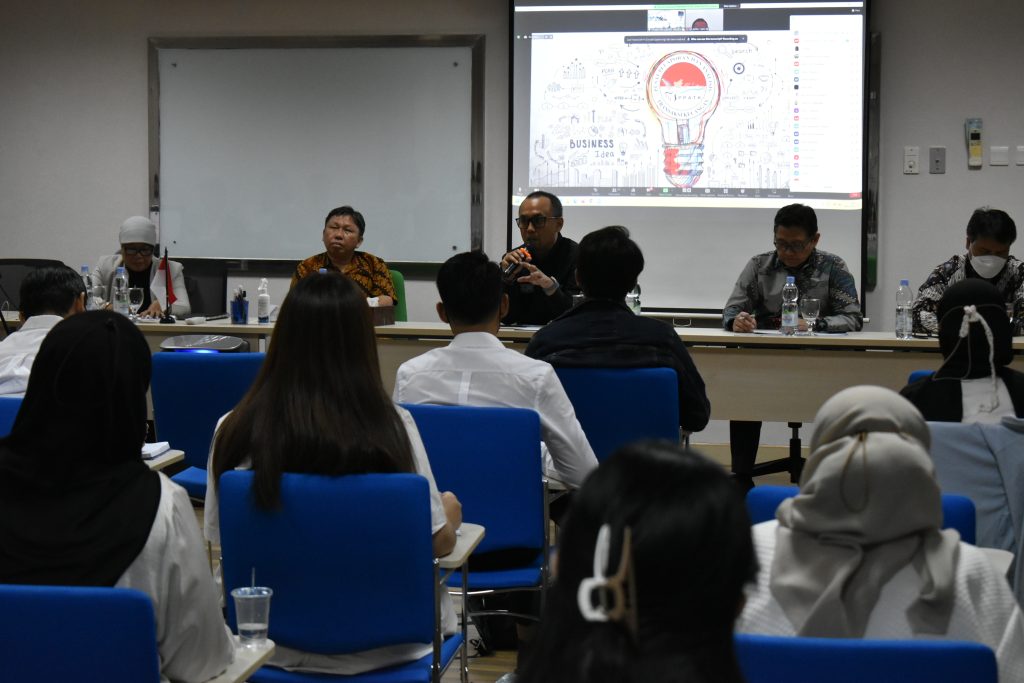
The Master of Laws Program (Jakarta Campus) hosted a public lecture featuring Dr. Ivan Yustiavandana, S.H., LL.M., Head of the Indonesian Financial Transaction Reports and Analysis Centre (PPATK), on Friday, February 10. The lecture opened with remarks from the Chair of the MIH Jakarta Program, Dr. Rikardo Simarmata, S.H., who expressed his hope that the session would serve as a warm-up for new students before they began their coursework in the Master of Laws Program.
This edition of the public lecture addressed economic crime -- one of the most pressing issues currently facing Indonesia. According to Dr. Ivan Yustiavandana, everyone who engages in money laundering ultimately seeks to enjoy the proceeds of their crime. It is precisely this notion of "enjoying" the proceeds that defines money laundering. In other words, anything done with illegally obtained wealth falls within the scope of money laundering -- as illustrated by past cases such as those of Akil Mochtar or Gayus Tambunan.
"People start thinking about how to receive, transfer, grow, and ultimately enjoy illegally obtained wealth. This is exactly the kind of thing we need to think through in terms of law enforcement." This was Dr. Ivan Yustiavandana's continued explanation.
Money laundering differs from other criminal offenses in that it cannot be addressed without touching upon bank secrecy. For this reason, money laundering was not incorporated into the Penal Code (KUHP); instead, a separate law and a new institution - known as the Financial Intelligence Unit/Center -- were established.
"Criminal acts today have become decentralised and unregulated. It's entirely possible that within a few years, developments will look different again, and the theories applied will need to evolve accordingly. It's no surprise, then, that a knowledge gap can emerge between what is taught on campus and what is encountered in the working world." This was Dr. Ivan Yustiavandana's further explanation.
Information technology today poses a danger far greater than nuclear weapons. Numerous cases of bullying and the misuse of information technology have placed people's lives at risk. Beyond this, artificial intelligence robotics continue to advance rapidly. What kind of legal framework, then, should be applied to such technology? The state and relevant authorities ought to pay close attention to this issue. If such matters are neglected, more and more people will fall victim to money laundering offenses.
"This isn't just about ensuring the law doesn't fall behind information technology -- it's also about the fate of human civilization itself. So, in order to prevent civilization from being swept under, the law we have must keep evolving. As Elon Musk once said, we need to be able to apply the brakes. Our hope is that the law can help apply that brake, so that humanity doesn't meet its own reckoning." This was Dr. Rikardo Simarmata's closing remark before bringing the public lecture to an end.