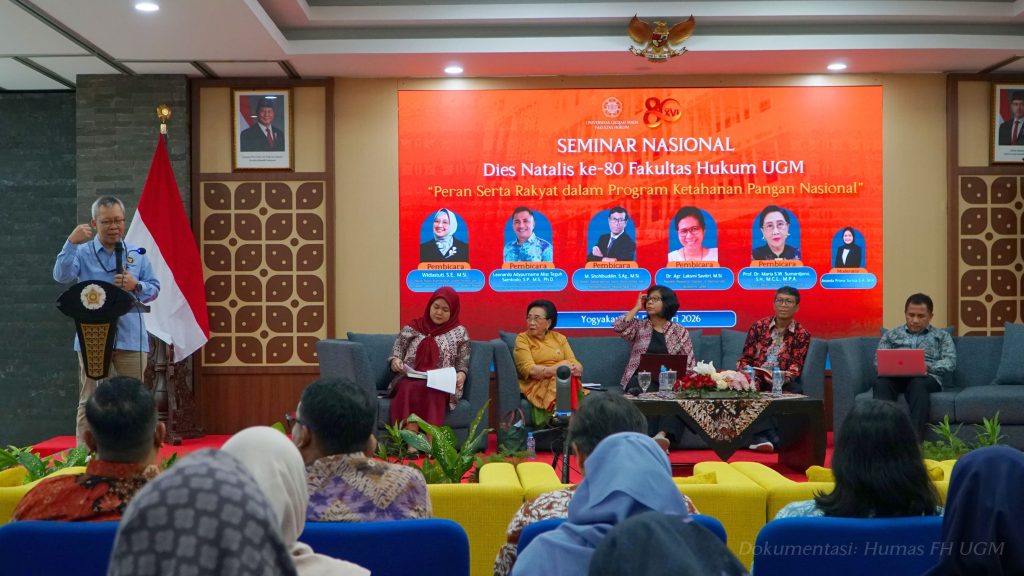
The Faculty of Law at Universitas Gadjah Mada hosted a national seminar titled "Public Participation in the National Food Security Program" on Wednesday, February 11, 2026, at the Auditorium of Building B, UGM Faculty of Law. The event was held as part of the 80th Dies Natalis celebrations of the UGM Faculty of Law and brought together academics, researchers, and government representatives to examine the issue of food security from the perspectives of policy, law, and community empowerment.
The seminar was opened with remarks from the Vice Dean for Academic Affairs, Student Affairs, and Partnerships, Prof. Adrianto Dwi Nugroho, S.H., Adv.LL.M., LL.D., who expressed his hope that the forum would offer participants a range of perspectives and valuable knowledge. The seminar featured speakers from a number of institutions. One of them was Leonardo Adypurnama Alias Teguh Sambodo, S.P., M.S., Ph.D., Deputy for Food Affairs at the Ministry of National Development Planning/National Development Planning Agency (Bappenas). In his presentation, he explained that Indonesia's food security policy is oriented toward transforming the food system to be more inclusive, affordable, and sustainable — through an ecoregion-based approach that draws on local potential and respects regional wisdom.
The next speaker, Ir. Darto Wahab, M.M., representing Widiastuti, S.E., M.Si. of the Coordinating Ministry for Food Affairs, outlined a number of strategic government programs aimed at achieving food self-sufficiency (swasembada pangan). He also emphasized the importance of public participation in accelerating the development of national food, energy, and water self-sufficiency zones.
Meanwhile, Dr. Mohammad Shohibuddin, S.Ag., M.Si., a lecturer at the Bogor Agricultural University (Institut Pertanian Bogor/IPB), highlighted the persistent depth of agrarian inequality in Indonesia, as reflected in a land Gini ratio of between 0.7 and 0.8. He argued that this inequality would appear even starker if landholding by smallholder farmers were compared directly with that of corporations.
He also raised a critical question about the position of ordinary people in the national food security program — asking whether communities are merely positioned as recipients of government assistance, or whether they are genuinely empowered as active participants with a meaningful role in building the food system.
UGM researcher Dr. Agr. Laksmi Savitri, M.Si. noted that the government's effort to provide food for the entire Indonesian population represents a well-intentioned political commitment — particularly in the context of an unstable global geopolitical environment. She cautioned, however, that the implementation of these policies needs to be examined critically, given the persistent inequalities and vulnerabilities in Indonesia's agrarian structure that could give rise to a range of problems in practice.
At the same session, Prof. Dr. Maria S.W. Sumardjono, S.H., MPA, Professor of Agrarian Law at UGM, affirmed that the National Food Security Program deserves full support as an expression of the state's responsibility to fulfill the fundamental right of every person to food. She stressed, however, that the natural resource governance policies underpinning it must satisfy the principles of agrarian justice and sustainability.
She cautioned that various food barn programs — including food estate projects — carry the potential to generate land conflicts, environmental damage, and structural injustice if their implementation disregards the protection of indigenous peoples, public participation, and the principles of equitable and sustainable natural resource management.
Through this seminar, the UGM Faculty of Law aims to make an academic contribution while strengthening dialogue between government, academia, and civil society in formulating national food security strategies that are inclusive and sustainable. The national seminar also supports the achievement of several Sustainable Development Goals (SDGs) — in particular SDG 2 (Zero Hunger) through its discussion of national food security; SDG 12 (Responsible Consumption and Production) in relation to sustainable food and resource management; and SDG 16 (Peace, Justice and Strong Institutions) through its examination of the legal, policy, and agrarian justice dimensions of natural resource governance. The involvement of academics, researchers, and government representatives also reflects the cross-sectoral spirit of collaboration that underpins SDG 17 (Partnerships for the Goals) in formulating inclusive and sustainable food policy solutions.