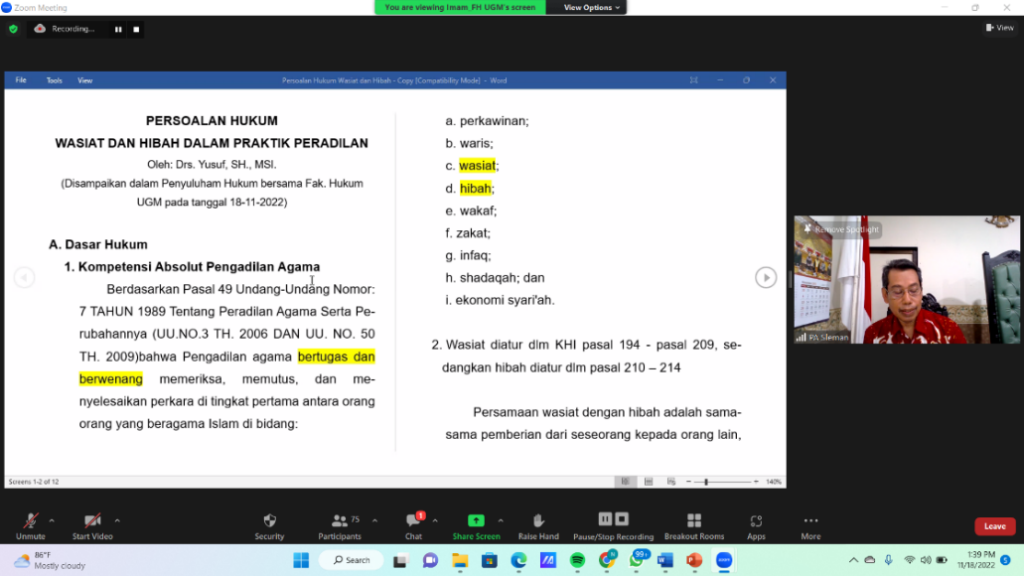
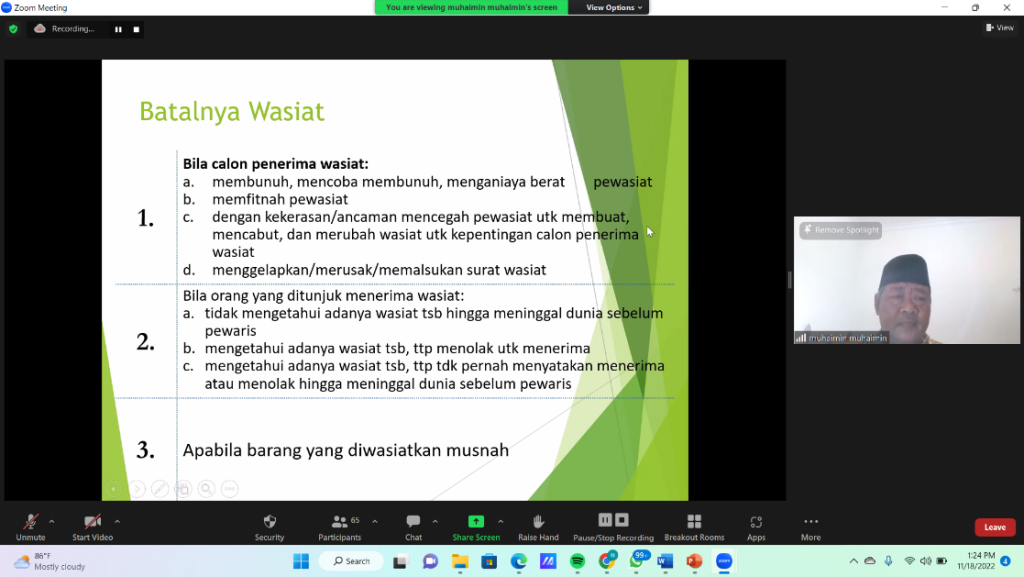
The Department of Islamic Law held its 11th Legal Outreach session on Friday, November 20, 2022, on the theme "Wills and Gifts under Islamic Law and Their Legal Issues in Practice." The speakers were Dr. Muhaimin, S.H., M.Kn. (lecturer, Department of Islamic Law, FH UGM) and Drs. Yusuf, S.H., M.SI. (Judge at the Sleman Religious Court).
After covering inheritance property in the previous month's session, the speakers this time explored one particular form of inheritance-related transfer: wills (Wasiat) and gifts (Hibah). Muhaimin's presentation examined Hibah and Wasiat through the lens of the Compilation of Islamic Law (KHI). He explained the KHI's definition of Hibah (Article 171 letter g) as a voluntary transfer of property, made without compensation, from one living person to another for that person to own. He also outlined specific conditions attached to Hibah: a gift from a testator to an heir can be counted toward that heir's inheritance share; a gift generally cannot be revoked, except in the case of a parent's gift to a child; and a gift made while the giver is in a condition considered close to death requires the consent of the giver's heirs.
As for Wasiat (a will), the KHI defines it as a transfer of property from a testator to another person or institution, taking effect after the testator's death. One particular form is the "obligatory will" (Wasiat Wajibah), governed by Article 209 of the KHI. This article addresses situations involving adoptive parents and adopted children who do not otherwise receive a bequest, granting them an obligatory will of up to one-third of the adopted child's or adoptive parent's estate. Over time, the scope of Wasiat Wajibah has expanded beyond adopted children and adoptive parents to include heirs who are not Muslim.
As a legal practitioner, Yusuf then discussed real-world problems that arise involving wills and gifts, such as: lack of agreement among heirs, property intended to be bequeathed having already been sold, the bequeathed object turning out to be jointly-owned marital property, a beneficiary turning out to be the mastermind behind a murder or attempted murder of the testator, and other similar issues. Participants and speakers also engaged in further discussion during a Q&A session. The strong turnout was reflected in the diversity of attendees, including students, lecturers, lawyers, civil servants, and even religious officiants (penghulu).
At the end of 2022, the Department of Islamic Law planned to hold one more legal outreach session, as the final installment in its collaborative Legal Outreach series with the Sleman Religious Court.
Writer: Fadhila Ardianti
Editor: Public Relations