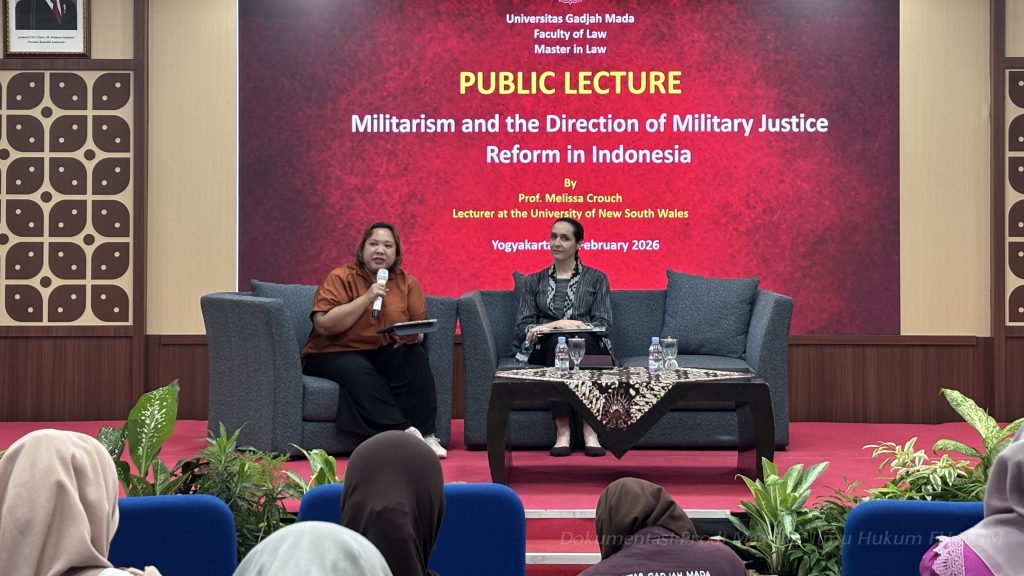
The Master of Laws Program (MIH) at the Faculty of Law, Universitas Gadjah Mada, successfully hosted a Public Lecture titled, Militarism and the Direction of Military Justice Reform in Indonesia, on Wednesday, February 18, 2026, at the Auditorium of Building B, UGM Faculty of Law. The lecture featured, Prof. Melissa Crouch (Professor and Associate Dean (Research), UNSW Law School, as the main speaker, with Dr. Mahaarum Kusuma Pertiwi, S.H., M.A., M.Phil., serving as moderator.
The public lecture was organized as a space for academic reflection and critical discourse — to examine in depth the position of military courts within a democratic rule-of-law state, and the urgency of legal reform oriented toward strengthening the rule of law, human rights protection, and the principle of civilian supremacy.
In her opening remarks, the Chair of the MIH Program at FH UGM, Herliana, S.H., M.Com.Law., Ph.D., expressed appreciation for Prof. Melissa Crouch\'s presence, having made the journey from Australia to share her knowledge and comparative perspective. She emphasized that the event not only enriches students\' academic understanding, but also serves as part of the international exposure program designed to foster the development of scholarly capacity in a global context.
In her presentation, Prof. Melissa Crouch explained that in contemporary global developments, the military no longer relies solely on coercive force — it also uses law and legal institutions to acquire and consolidate power. This phenomenon is visible across various regions, from Asia and the Middle East to Latin America. She highlighted that military involvement in institutions traditionally considered civilian in nature — such as parliaments, the executive, and the judiciary — challenges the foundational democratic assumptions of accountability and representation.
Through a comparative lens, Prof. Melissa also drew on the experiences of several countries, including Myanmar and Thailand, to illustrate how civil-military relations shape the trajectory of democracy and law enforcement. In the Indonesian context, she identified a number of strategic issues — including the ongoing debate over expanding the military\'s role in civilian affairs, the relationship between military courts and general courts, the problem of impunity, and the importance of strengthening effective civilian control.
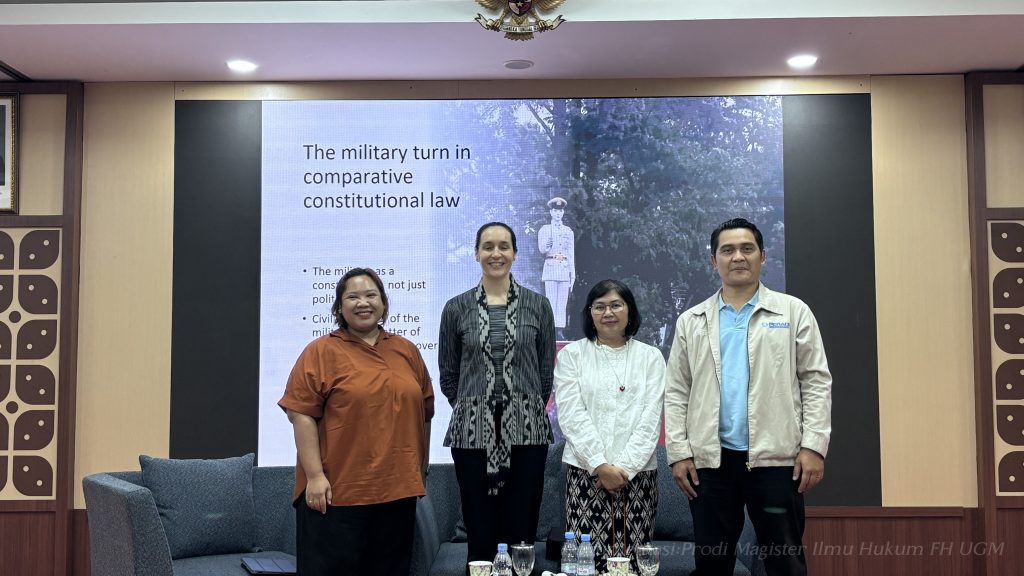
The lively and interactive discussion that followed demonstrated considerable enthusiasm among participants. Questions touched on the failures of security sector reform after 1998, the possibility of a resurgent military role in the context of global geopolitics and natural resource political economy, the military\'s role in democratization processes, and the phenomenon of militarization within civilian institutions. In response, Prof. Melissa emphasized that security sector reform in Indonesia has achieved significant changes — such as the separation of the Indonesian National Police (Polri) from the Indonesian National Armed Forces (TNI) and the strengthening of the constitutional framework — but has not yet fully addressed structural issues, including military involvement in economic activities and the influence of retired officers in politics.
The organization of this public lecture also contributes to the achievement of the , Sustainable Development Goals (SDGs),— specifically SDG 4 (Quality Education), by providing an inclusive, critical, and globally oriented academic learning space; SDG 16 (Peace, Justice and Strong Institutions)', by strengthening discourse on the rule of law, transparency, accountability, and equality before the law; and SDG 17 (Partnerships for the Goals) through international academic collaboration that brings in resource persons from overseas higher education institutions to enrich national legal scholarship. In doing so, the event reaffirms the commitment of the UGM MIH Program to delivering globally competitive academic forums oriented toward the strengthening of a democratic rule-of-law state.
This event reaffirms the commitment of the Master of Laws Program at the UGM Faculty of Law to continue providing spaces for academic dialogue that are critical, constructive, and oriented toward the strengthening of a democratic rule-of-law state and the achievement of the sustainable development agenda.
Author: Master of Laws Program, Faculty of Law UGM