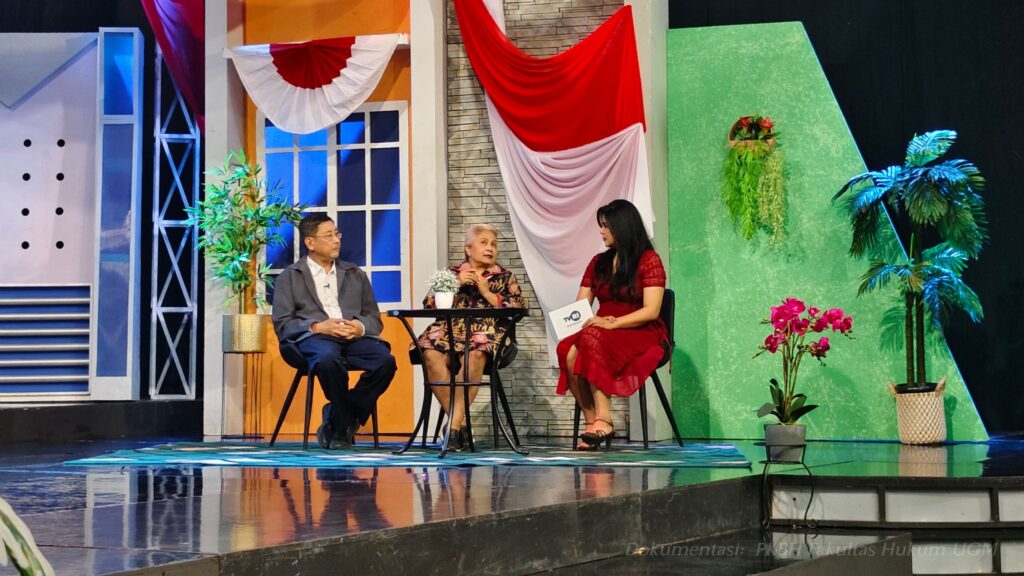
The Faculty of Law at Universitas Gadjah Mada (FH UGM), through its Legal Consultation and Assistance Centre (PKBH) unit, worked with TVRI Yogyakarta to hold a legal outreach program titled "Tracing the Existence of Sultanate Land from Legal and Historical Perspectives." The program was packaged as a talk show broadcast live from the TVRI Yogyakarta studio and aired on TVRI's official television channel and YouTube on Tuesday, August 11, 2026, at 3:00 p.m. WIB.
The program was designed to widen legal education for the public so that the discussion particularly on the status of Sultanate Land (Tanah Kasultanan) in the Special Region of Yogyakarta (DIY) is not confined to formal academic settings. By using public broadcast media, legal knowledge about Sultanate Land in DIY, the main subject of this outreach, can be accessed openly by the general public. Besides offering a basic understanding of the special character of land affairs in DIY, the forum aims to correct various misunderstandings circulating among the public and to prevent legal violations that touch on Sultanate Land.
The Position of Land Affairs Within the Framework of DIY's Special Status
As is well known, land affairs are one of the five pillars of DIY's special status, which was confirmed by Law No. 13 of 2012 on the Special Status of DIY (UUK DIY). The existence of the UUK DIY also confirms that land governance in DIY has its own special character and is not automatically made uniform with national land regulations. The recognition of the existence of Sultanate Land gives legal certainty (rechtssicherheit) grounded in objective fact and logical consistency.
The recognition of the existence of Sultanate Land and Duchy Land (Tanah Kadipaten) in the UUK DIY indicates a transformation in the recognition of realities of both the past and the future. This recognition of a legal norm rests on objective truth that can be demonstrated through experience and observation, and on logical consistency supported by related historical evidence, whether direct or indirect. From this arises a firm legal certainty (Rechtssicherheit), not merely a pragmatic or relative truth that shifts with subjective points of view.
A Historical Approach (Historisch Bestimmt) to Sultanate Land in DIY
The discussion in this outreach showed that law and history are very closely linked. In the DIY context, the rights that DIY holds are the result of the historical processes it has been through. A full understanding of DIY's special status in land affairs therefore calls for a legal-history approach to examine legal phenomena of the past, taking into account historical facts, social conditions, and the special character of the region. Such historical tracing requires verifying authentic evidence, including legislation from the Dutch East Indies colonial era, Western legal systems and rights such as the Recht van Eigendom (RVE), and the dynamics of the national land system.
Clarifying the status of Sultanate Land, as discussed in this outreach, has strategic significance for strengthening institutional land governance and protecting people's rights, and for preventing potential disputes over land ownership claims in the future. The outreach is also a way of informing the public in order to prevent the misuse of Sultanate Land in ways that conflict with existing rules.
A Cross-Disciplinary Discussion
To place the issue in its full context, the talk show featured two experts in their fields:
- Dr. Harto Juwono, M.Hum. (Lecturer, History Study Program, Faculty of Cultural Sciences, Universitas Sebelas Maret), who explored the historical dynamics and intricacies of land affairs in DIY from the Dutch East Indies period to the contemporary era.
- Dr.jur. Any Andjarwati, S.H., M.jur. (Lecturer, Department of Agrarian Law, Faculty of Law, UGM), who presented a juridical analysis from the standpoint of land law and the regulations on DIY's special status.
The legal outreach also indirectly aligns with the target of UN Sustainable Development Goal (SDG) 16, namely realizing peace, justice, and strong institutions. FH UGM also extends its appreciation to TVRI Yogyakarta for the collaboration that allowed this legal outreach to go well and reach a wide audience.
Author: Daisyta Mega Sari (PKBH, Faculty of Law, UGM)