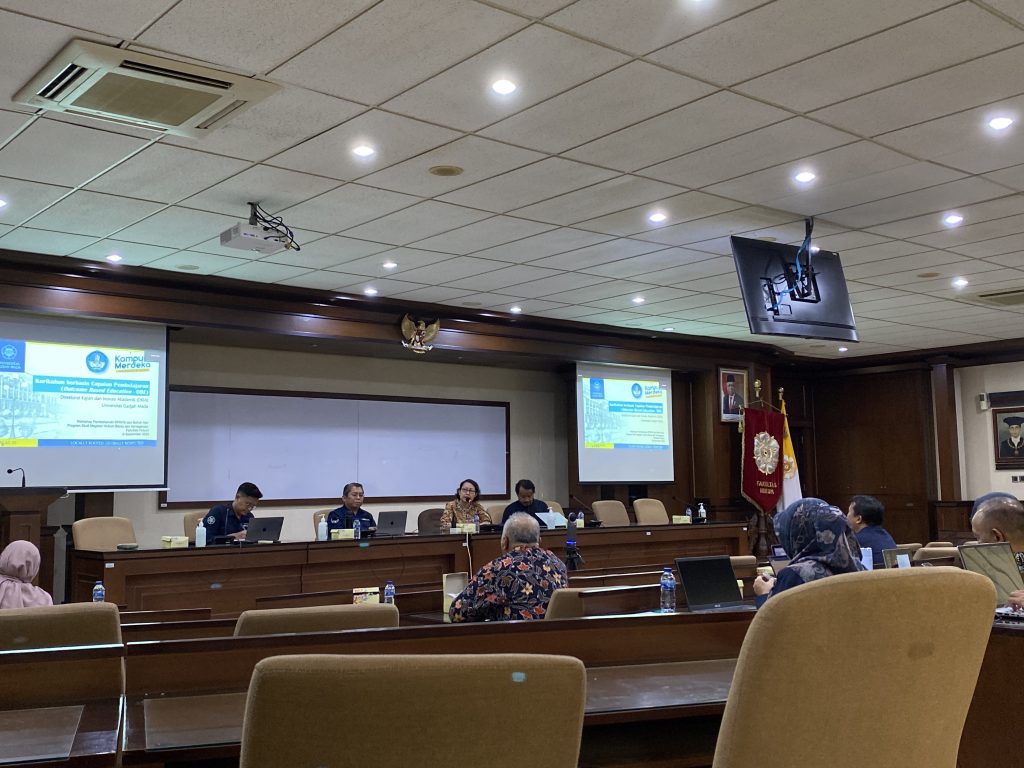
On Wednesday (September 6), the Master of Business and Public Law (MHBK) program at the Faculty of Law, Gadjah Mada University, held a workshop on updating the Semester Learning Activity Plan (RPKPS) and teaching materials for the fall semester for the Master of Business and Public Law program. The workshop, held in Room 3. I. I of the UGM Faculty of Law, was opened by Dr. Mailinda Eka Yuniza, S.H., LL.M., Vice Dean for Finance, Assets, and Human Resources. This was followed by remarks from Irna Nurhayati, S.H., M.Hum., LL.M., Ph.D., Chair of the MHBK Program. A total of 20 faculty members who teach courses in the MHBK program participated in this event.
The Workshop on Updating the Semester Learning Activity Plan (RPKPS) and Teaching Materials was held in two sessions. The first session was led by Dr. Irwan Endrayanto, S.Si., M.Sc., who presented material on the Semester Learning Activity Plan (RPKPS) for Outcome-Based Education (OBE) Key Performance Indicator (IKU7). The subsequent session was a Workshop on Updating the RPKPS and Teaching Materials, facilitated by the Quality Assurance and Academic Innovation Unit.
During the workshop, it was noted that there have been changes to the regulations governing the development of the RPKPS, as stipulated in Ministry of Education, Culture, Research, and Technology Regulation No. 53 of 2023 on Quality Assurance in Higher Education. The development of the RPKPS using the Outcome-Based Education (OBE) approach in the curriculum consists of the following elements: Outcome-Based Curriculum (how the curriculum is developed based on Graduate Learning Outcomes), Outcome-Based Learning and Teaching (how Graduate Learning Outcomes are achieved), and Outcome-Based Assessment and Evaluation (how the achievement of Graduate Learning Outcomes is ensured). The primary focus in developing the RPKPS is on how to assess the achievement of learning outcomes. In relation to the CPMK, assessment methods need not rely heavily on semester exams but can also incorporate components such as group work, discussions, presentations, and so on into the assessment. This aims to diversify assessment methods and ensure a more holistic evaluation of learning outcomes.
The workshop then concluded with a question-and-answer session. Faculty members used this session to ask questions and seek clarification regarding the development of the RPKPS. The workshop was held not only as a form of support for the UN Sustainable Development Goal 4 on quality education, but also with the hope of improving the quality of the Master’s Program in Business and Public Law at Gadjah Mada University.
Author: MHBK
Editor: PR