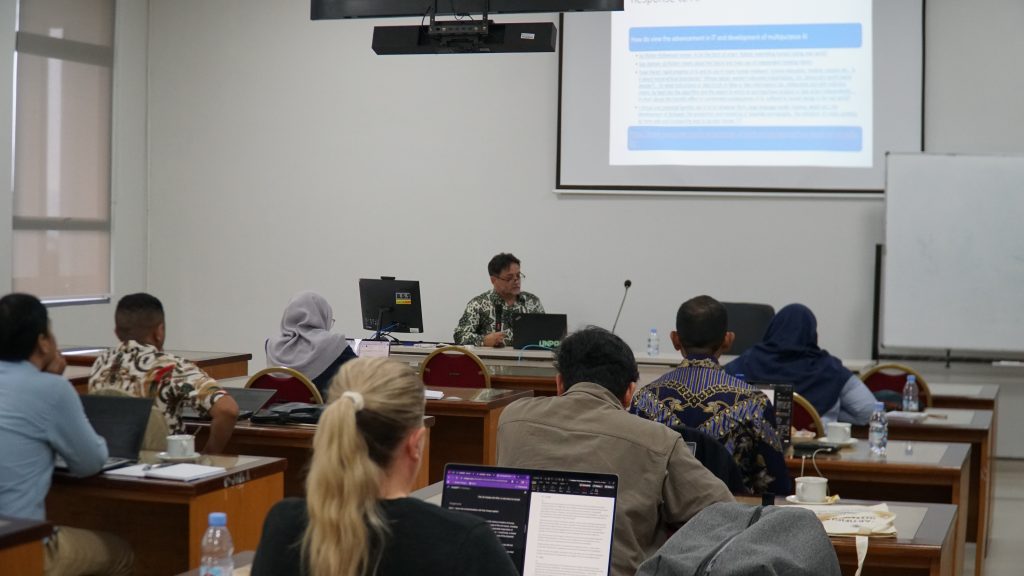
From Tuesday (October 14, 2025) through Thursday (October 16, 2025), the Faculty of Law at Gadjah Mada University (FH UGM) hosted a three-day series of short courses as part of the Monash University Law Indonesia Alliance (MULIA) Annual Meeting 2025. Centered on the topic “Artificial Intelligence in a Legal Context,” this program served as an interactive learning forum bringing together legal scholars and practitioners from various member universities of the alliance to discuss current global legal issues.
MULIA is a collaboration between the Monash University Faculty of Law and seven leading law schools in Indonesia: Airlangga University, Hasanuddin University, the University of Indonesia, Padjadjaran University, Pelita Harapan University, Sam Ratulangi University, and Gadjah Mada University. Established in 2023, this alliance focuses on developing clinical and experiential legal education and strengthening cross-institutional academic collaboration.
The proposed MULIA 2025 short course at the UGM Faculty of Law was attended by faculty members and students from the Monash University Faculty of Law and the Gadjah Mada University Faculty of Law. The material was presented by speakers from both the legal profession and academia, including faculty members from the UGM Faculty of Law, the Monash University Faculty of Law, and other external speakers. On October 14, 2025, the program began with two main topics: “AI Adoption: The Legal Nuts and Bolts” by Bhredipta Socarana, S.H., LL.M., CIPP/E., and “AI as a Legal Person” by Dr. Tristam P. Moeliono, S.H., M.H., LL.M. The event continued on October 15, 2025, with three additional topics: “AI Governance” by Prof. Paul Burgess, “Legal Issues of Generative AI in Copyright Law” by Laurensia Andrini, S.H., LL.M., Ph.D., and “Critical Challenges and Integrated Solutions in the Implementation of the Digital Rupiah in Digital Economic Systems” by Alfatika Anunuriella Dini, S.H., M.Kn., Ph.D. Through this series of topics, participants were guided to understand various legal aspects of digital technology advancements, such as artificial intelligence governance, legal liability, and regulatory challenges in implementing technological innovations in the economic sector.
In addition to the academic sessions, participants took part in an excursion on October 16, 2025, to Kembangarum Tourism Village in Sleman. This event provided a cultural experience and fostered camaraderie among participants through local activities such as the VW Safari tour, jemparingan (traditional archery), and workshops on batik and gamelan.
The organization of this short course aligns with the UGM Faculty of Law’s commitment to supporting the Sustainable Development Goals (SDGs), particularly SDG 4 (Quality Education) through enhancing legal and technological literacy among academics and practitioners, SDG 9 (Industry, Innovation, and Infrastructure) by promoting the integration of technological innovation into legal and economic systems; and SDG 17 (Partnerships for the Goals) through international cross-university collaboration. Through this event, the UGM Faculty of Law reaffirms its role as a hub for global academic collaboration that advances legal education grounded in innovation, ethics, and sustainability.