
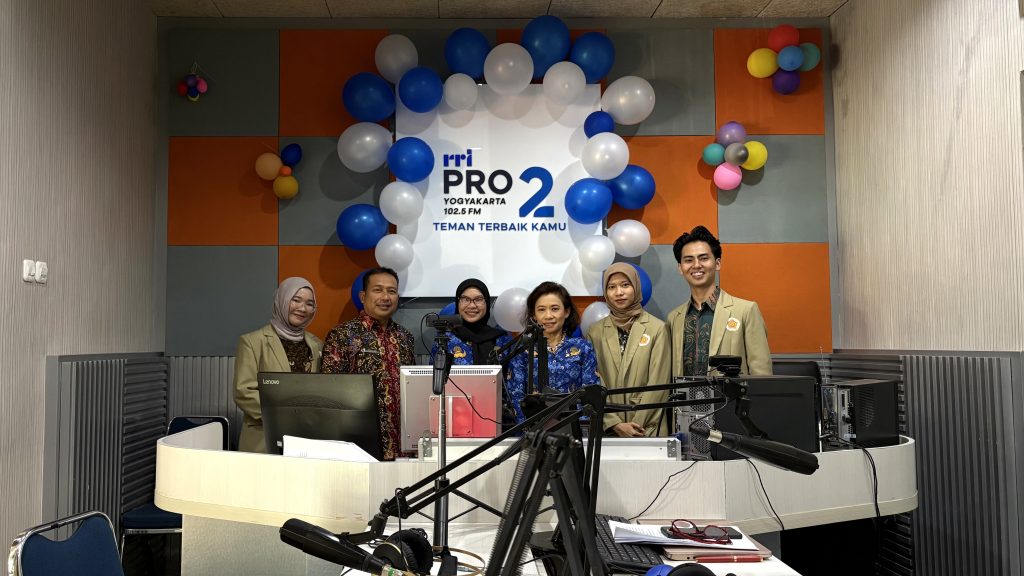
The Legal Consultation and Assistance Center (PKBH) of the Faculty of Law at Gadjah Mada University (UGM), in collaboration with the Master’s Program in Notarial Law at the UGM Faculty of Law and Radio Republik Indonesia (RRI) Yogyakarta, organized a legal awareness event titled “Let’s Mark Land Boundaries: The First Step in Preventing Land Disputes.” This event aims to enhance the public’s legal knowledge and awareness to help prevent land disputes, particularly regarding the importance of establishing land boundaries.
This event was broadcast live from the RRI Pro 2 Studio in Yogyakarta on Wednesday (August 17, 2025) from 12:00 p.m. to 12:30 p.m. WIB. Three speakers participated in the event: Dr. Ir. Margaretha Elya Lim Putraningtyas, S.T., M.Eng., Head of the Kulon Progo Regency Land Office and Lecturer on Electronic Transactions in Notarial Studies at the Master’s Program in Notarial Studies at Gadjah Mada University; Trigus Eko, S.T., M.T., Head of the Survey and Mapping Section at the Gunungkidul Regency Land Office; and Dadang F
This legal outreach session was held in response to the high number of land disputes occurring in the community due to the absence of clear land boundary markers. Clear land boundary markers are crucial to be placed at every corner of a plot of land, yet this is often overlooked by the public. The speakers emphasized that land boundary markers are not merely symbolic demarcations but also serve as physical evidence of clear land boundaries and as a first step toward guaranteeing and protecting property rights.

Boundary markers are permanent points that serve as clear references for determining the position of a parcel of land. Landowners who install and maintain boundary markers demonstrate responsibility and protect their land ownership. Proper installation also provides legal certainty for both the landowner and adjacent parties.
In the community, land boundary markers are installed in various forms and types, such as iron pipes, PVC pipes filled with concrete, iron-reinforced wood, bengkirai wood, teak, brick monuments, carved granite, or river stones. However, the most important aspect of installing land boundary markers is that they must be secure, strong, not easily damaged or moved, durable, and easily recognizable. Differences typically lie in the size and depth of the boundary marker’s portion embedded in the ground.
In practice, the installation of boundary markers is based on the adversarial principle of delimitation—a principle in land registration that requires notification to adjacent landowners so they can witness and jointly agree on the boundary markers before land surveying and registration take place. This is important to ensure the surveying process is transparent and to prevent future disputes.
Furthermore, Trigus Eko, S.T., M.T., explained that the stages of boundary marker installation include obtaining consent from adjacent landowners, surveying and establishing land boundary points, installing boundary markers in the presence of relevant parties, reporting and documentation, and concluding with the maintenance of the boundary markers. Through these steps, legal certainty can be guaranteed, and the community is also encouraged to take a more active role in maintaining their land.
Closing the broadcast, Dr. Ir. Margaretha Elya Lim Putraningtyas, S.T., M.Eng., emphasized that the installation of land boundary markers aligns with the government’s program through the Community Movement for the Installation of Land Boundary Markers (GEMAPATAS), which was initiated by the Ministry of Agrarian Affairs and Spatial Planning/National Land Agency (ATR/BPN) in 2023. This program aims to raise public awareness about installing and maintaining land boundary markers, prevent land conflicts arising from boundary disputes, and secure land assets in a sustainable manner.
This legal outreach is also closely linked to efforts to achieve the Sustainable Development Goals (SDGs) in Indonesia. The installation of land boundary markers contributes to SDG 1 (No Poverty) because legal certainty regarding land protects community assets as a source of livelihood. Furthermore, it aligns with SDG 11 (Sustainable Cities and Communities), as clear land boundaries support orderly and sustainable urban and rural development. This outreach also supports SDG 16 (Peace, Justice, and Strong Institutions) as a preventive measure against land conflicts.
Through the collaboration between the PKBH FH UGM, the Master’s Program in Notarial Law at FH UGM, and RRI Yogyakarta, this legal outreach program is expected to serve as a public education tool to raise public awareness of the importance of installing land boundary markers as a first step toward preventing land disputes and providing tangible support for achieving the SDGs in Indonesia.
Author: Legal Outreach Team, Master’s Program in Notarial Law, Faculty of Law, Gadjah Mada University