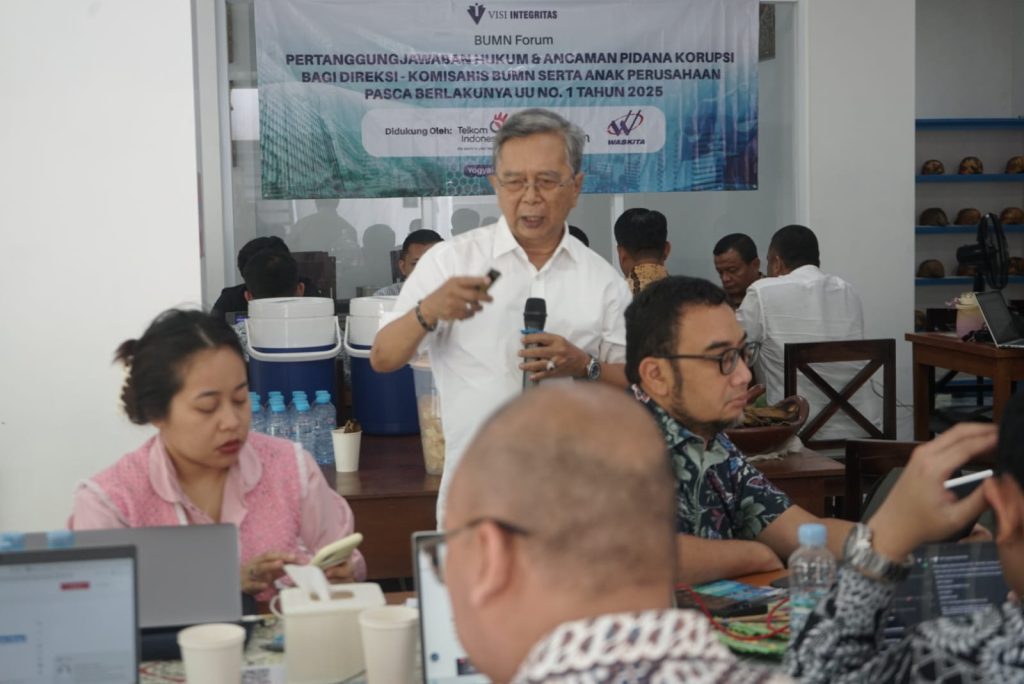
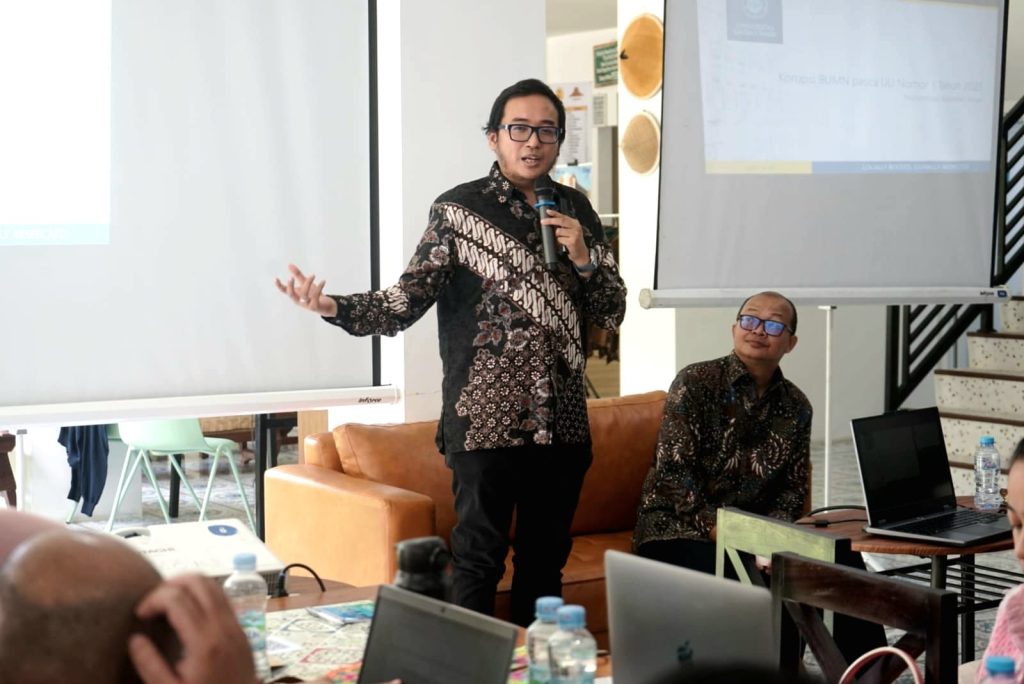
On Friday, June 13, 2025, VISI INTEGRITAS hosted a public discussion on the legal responsibilities and corruption risks faced by the directors and commissioners of State-Owned Enterprises (SOEs) following the enactment of the new SOE Law. The event was held at Resto Kalibayem in Bantul and featured two speakers from the Faculty of Law at Gadjah Mada University: Dr. M. Fatahillah Akbar, S.H., LL.M., a lecturer in Criminal Law, and Prof. Dr. Nindyo Pramono, S.H., M.S., a Professor of Business Law and legal practitioner. In addition to the speakers from the UGM Faculty of Law, Emerson Yuntho, Director of Visi Integritas and an anti-corruption activist, also served as a speaker.
This forum aims to provide a comprehensive understanding of the legal substance of the new State-Owned Enterprises Law and its implications for criminal liability in corruption cases. Participants in the discussion include Top Management (Board of Commissioners and Board of Directors), Corporate Middle Management (SOEs/D), Compliance Teams, Legal Teams, Internal Audit Units, Legal Practitioners, and the general public.
Dr. Akbar delivered a presentation titled “Can State-Owned Enterprises Be Charged with Corruption for Financial Losses Following the Enactment of the New SOE Law?”, which discussed the potential expansion of criminal liability in the context of financial losses to the state caused by state-owned enterprises. Meanwhile, Prof. Dr. Nindyo Pramono presented a session titled “The New SOE Law and Legal Liability for SOE Directors and Commissioners”, which examined the principles of legal accountability in the governance of state-owned enterprises based on the latest legislation. These presentations provided a strategic perspective on formulating policies and making decisions in alignment with the principles of responsible corporate law.
This forum is also intended as an educational platform for SOE stakeholders—including board members, commissioners, and management—to gain a deeper understanding of the legal framework governing the fulfillment of corporate responsibilities. It is hoped that these discussions will help prevent practices that could lead to criminal offenses, particularly corruption, and foster a culture of integrity and good governance within SOEs.
Furthermore, this forum promotes professionalism and regulatory compliance as part of efforts to strengthen accountability in the public sector. By upholding the principle of integrity, this initiative also helps to strengthen governance that supports the achievement of sustainable development.
The active participation of UGM Law Faculty academics in this discussion reflects the institution’s commitment to supporting the achievement of the Sustainable Development Goals (Sustainable Development Goals/SDGs). This activity contributes to SDG 4 (Quality Education), through the enhancement of legal literacy for leaders in the business sector; SDG 16 (Peace, Justice, and Strong Institutions), by emphasizing the importance of transparent and accountable legal governance; and SDG 17 (Partnerships for the Goals), through active collaboration between academics and the industry sector in addressing contemporary legal challenges.
In conclusion, this forum serves as a strategic platform for knowledge exchange between academics and practitioners. The discussions not only enhanced participants’ understanding of the new regulations but also strengthened the foundation for implementing ethical business practices within the framework of sustainable national legal development. The SOE Forum discussion at Resto Kalibayem served as a vital platform for knowledge exchange and collaboration, emphasizing the role of education in promoting sustainable practices within state-owned enterprises.