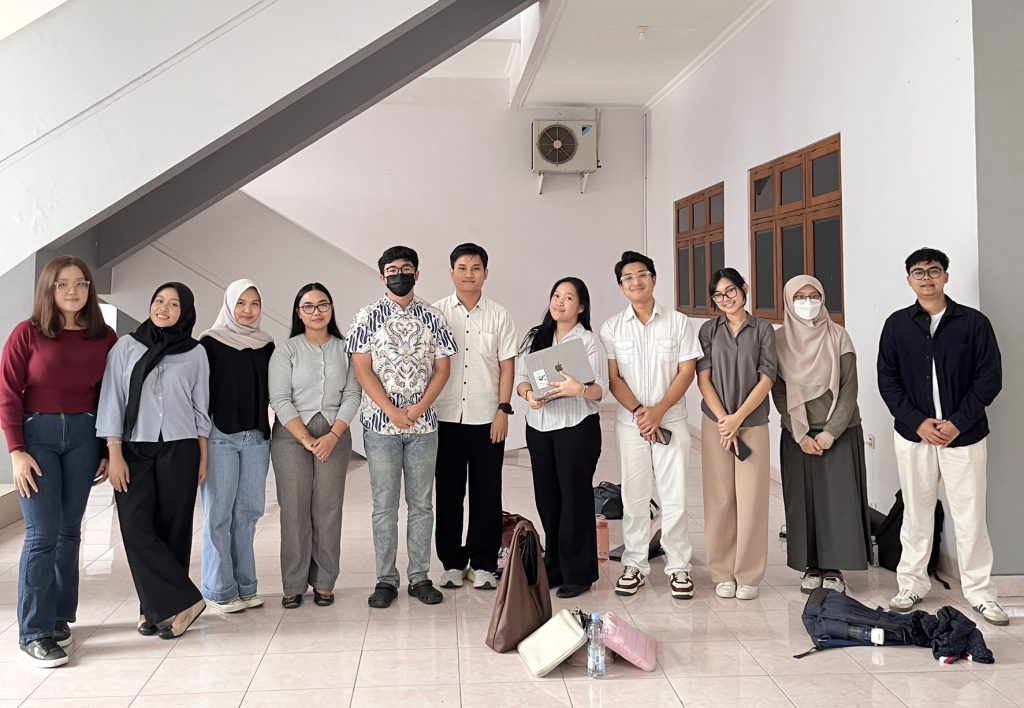
On Tuesday (May 27, 2025), the Law Development Division of ALSA LC UGM once again held an informal discussion forum titled DIALEKTIKA. This edition explored the theme “Examining the Reality of Criticism in the Contemporary World: Between Public Voice and State Regulation.” Participants discussed an issue currently in the spotlight within legal discourse and civil liberties: the distinction between constructive criticism and hate speech in contemporary public spaces.
The discussion was opened by Kezia Alicia, who highlighted the surge in criticism of the government on social media in recent years. She questioned the line between hate speech and constructive criticism. In response, Jeremy Kevin explained that, in essence, constructive criticism aims to offer suggestions for improvement, whereas hate speech is often expressed in a manner that violates standards of decency and tends to be personally attacking. The case of an ITB student who posted visual criticism of a government official is an example of a violation of Article 27 of the ITE Law; however, the penalty for such an offense may be mitigated.
Vincensius Jovan then responded that the content could be interpreted as a form of free speech, but acknowledged that it could cause discomfort, making it reasonable for the authorities to take action. However, Maharani Fadia disagreed with this view, describing the action as a legitimate form of public resistance against injustice.
The discussion continued with an examination of the dynamics on social media, which revealed a polarization of public opinion regarding the ITB student case currently in the spotlight. Kezia Alicia noted that public solidarity appeared weak in this case, with some netizens viewing the students’ criticism as a way of stirring up trouble, while others saw it as an effort to be heard by the government. Jessica Manullang responded that the students’ actions, though controversial, reflect anxiety about the current political climate. She also noted that platforms like X (Twitter) are not formal spaces, but can serve as effective channels for criticism—though they remain risky.
Gerald Xaverius then raised the question of why cases involving criticism of the government tend to be processed more quickly through the legal system than other cases, such as corruption. Fatima Aliyya responded that this reflects the power imbalance between the government and the people. The government is seen as being very protective of its image to ensure the smooth implementation of its programs and the stability of the country. She also noted that other cases, such as corruption, are harder to prove because they involve the ruling elite. In this regard, Gerald Xaverius added that critics are indeed easier to identify because they are generally not government officials or part of the elite.
In this discussion, Kezia Alicia Alicia and Gerald Xaverius also highlighted how governments at all levels—from the national to the village level—are willing to expend resources to maintain their image. This is seen as a reflection of the public’s lack of political education, which, according to Fatima Aliyya, is the root cause of disparities in how people address national issues.
The discussion then shifted to a comparison between repressive states and apathetic societies. Kezia Alicia asked which was more dangerous, and Jeremy Kevin replied that both pose a threat to national stability. He added that often, the public lacks formal channels for expressing criticism, leading to uncontrolled methods.
From a legal perspective, Kezia Alicia pointed out that although the ITE Law appears objective on the surface, its implementation is often subjective, depending on the perspective of law enforcement officials, and the ITE Law is more frequently used to prosecute defamation cases. Vincensius Jovan stated that the government’s power dynamics make the implementation of the law difficult and not always fair. Fatima Aliyya and Vincensius Jovan also touched on the relevance of the ITE Law in handling cases such as revenge porn, which are more appropriately addressed through the TPKS Law.
The discussion concluded with the observation that criticism is an essential part of democracy, but the unfair enforcement of laws can stifle that freedom of expression. While the ITE Law is indeed relevant for prosecuting digital crimes, it still requires evaluation in the context of specific cases, and it is important for law enforcement officials to assess each case objectively and proportionately.
Through this discussion, participants are expected to gain a deeper understanding of the complexities surrounding freedom of expression, the law, and power. Criticism is not a threat, but rather a reflection of a society that cares and wants to contribute to building a better and more accountable government.
This public discussion reflects the active commitment of UGM Law Faculty students to supporting the achievement of the Sustainable Development Goals (SDGs) , particularly SDG 4 on Quality Education which promotes critical learning, as well as SDG 16 on Peace, Justice, and Strong Institutions which emphasizes the importance of freedom of expression, access to justice, and public participation in policymaking. By providing an open and inclusive discussion space, this event helps strengthen legal awareness and foster a healthy democratic culture among students as future leaders of the nation. This forum also demonstrates the tangible contribution of the academic community in building a just society that is responsive to the social and legal challenges faced by today’s youth.
Author: Fatima Aliyya Raihandra (ALSA LC UGM)