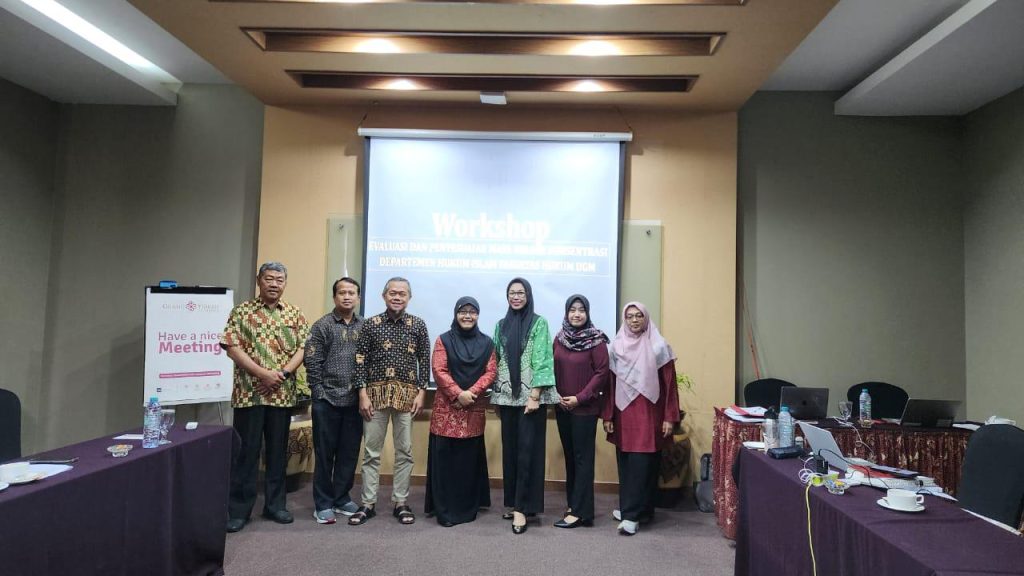
The Department of Islamic Law at the Faculty of Law, UGM, held a workshop on the development of new concentration courses in preparation for the 2026 curriculum. The workshop involved relevant experts and practitioners. The proposed courses are Security Interests in Sharia Contracts, Contemporary Islamic Family Law, and Sharia Contract Drafting. The workshop was held on Thursday (August 7, 2025) at the Grand Tjokro Hotel in Yogyakarta. It was attended by all faculty members of the Department of Islamic Law at the Faculty of Law, UGM, namely Prof. Dr. Hartini, S.H., M.Si., Dr. Muhaimin, S.H., M.Kn., Dr. Yulkarnain Harahab, S.H., M.Si., Dr. Destri Budi Nugraheni, S.H., M.S.I., Dr. Khotibul Umam, S.H., LL.M., and Haniah Ilhami, S.H., LL.M.
In her opening remarks, the Chair of the Department of Islamic Law at the Faculty of Law, UGM, Prof. Dr. Hartini, S.H., M.Si., stated that the development of these three new concentration courses is part of an effort to review and prepare for the formulation of the 2026 Curriculum. Based on the 2021 Curriculum, the Department of Islamic Law has been offering seven concentration courses. The purpose of this workshop was to gather input on the structure and substance of the new courses to be developed, in line with both theoretical and practical dimensions, as well as legal developments in society.
There were three sessions presented by practitioners and experts in this workshop. The first two sessions were led by guest speakers, while the final session consisted of an internal discussion among faculty members in the Department of Islamic Law. The first session was presented by Justicia Eka Puspita, S.H., M.Kn, a practicing notary/PPAT. In this session, Justicia emphasized the regulations and practices of collateral in sharia financing. The next session was presented by the Deputy Chairman of the Indonesian Ulema Council (MUI) for the Special Region of Yogyakarta (DIY), Dr. KH. Ahmad Zuhdi Muhdlor, S.H., M.Hum., and the Head of the Islamic Religious Affairs Division (Urais) at the Regional Office of the Ministry of Religious Affairs for the Special Region of Yogyakarta (DIY), Dr. Halili, S.Ag., M.S.I. In this session, Dr. Ahmad Zuhdi discussed the challenges of understanding and enforcing contemporary Islamic family law. Meanwhile, Dr. Halili focused on developments in the Ministry of Religious Affairs’ regulations and policies regarding religious affairs in the field of marriage and developments in regulations governing the management of religious social funds.
All faculty members of the Department of Islamic Law at the Faculty of Law, UGM, actively engaged with the speakers’ presentations, provided feedback on the proposed course materials for the courses “Security in Sharia Contracts,” “Contemporary Islamic Family Law,” and “Drafting Sharia Contracts,” and discussed related legal issues. Through this workshop, it is hoped that the material in the new courses will align with developments in society, that high-quality learning materials will be created, and that a shared understanding will be established between academics and stakeholders.
This workshop also contributes to the achievement of the Sustainable Development Goals (SDGs), particularly SDG 4 (Quality Education), by providing a curriculum that is relevant, adaptive, and in line with legal developments in society. Furthermore, the development of new courses emphasizing Sharia, family law, and religious contracts supports SDG 16 (Peace, Justice, and Strong Institutions) by strengthening legal capacity that is fair and upholds integrity. Furthermore, the involvement of practitioners and external stakeholders reflects SDG 17 (Partnerships for the Goals), as the curriculum development process is carried out collaboratively among academics, practitioners, and religious institutions to produce a more comprehensive and practical Islamic legal education.
Author: Mastri Imammusadin, S.H. (Department of Islamic Law) Editor: Public Relations