Can the regulatory developments in State Administrative Law (Hukum Administrasi Negara/HAN) and the strengthening of the State Administrative Court (Pengadilan Tata Usaha Negara/PTUN/Peratun) over the past decade-plus be characterized as progress, stagnation, or regression? Have HAN scholars successfully guided government policy in the right direction? Has HAN teaching equipped students to remain vigilant and take principled intellectual positions amid the ebbs and flows of the rule of law and democracy?
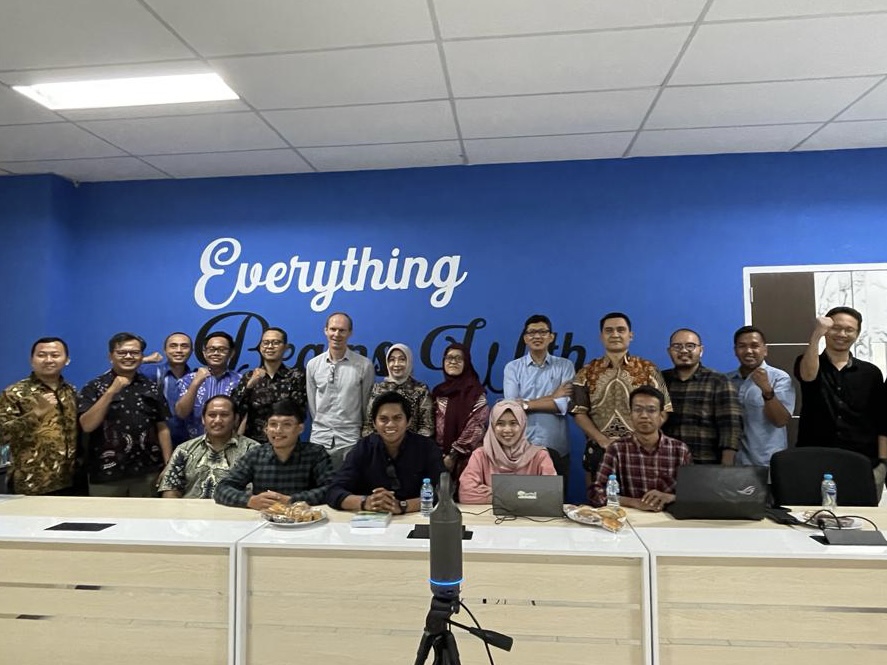
These are precisely the questions that prompted the Department of State Administrative Law, together with two research centers (Pusat Kajian/Puska) at the UGM Faculty of Law, the Centre for Law and Social Justice (LSJ) and the Centre for Democracy, Constitutional Law, and Human Rights (Pandekha), to organize a talkshow titled "Which Direction Should Administrative Law Education in Indonesia Take?" The event was held in a hybrid format on Thursday, January 18, 2024, at the UGM Faculty of Law, streamed via Zoom and broadcast on the Faculty of Law's YouTube channel (Kanal Pengetahuan). The event also reflects UGM's commitment to SDG 4 on Quality Education.
Three discussion anchors attended in person: Adriaan Bedner, Professor at Leiden Law School; I Gusti Ayu Ketut Rachmi Handayani, Professor of HAN and Dean of the Faculty of Law at Universitas Sebelas Maret (UNS); and Richo Andi Wibowo, Head of the HAN Department at the UGM Faculty of Law. The session was moderated by Herlambang Perdana Wiratraman, Chair of the LSJ Research Centre. Respondents and discussants joined from a wide range of backgrounds — including PTUN judges attending both online and in person (from Yogyakarta, Jakarta, Mataram, and elsewhere), HAN and Public Administration academics from UMY, Unand, Unpar, Unpad, UII, UNS, Unmul, and Untan, as well as civil servants and students from different levels of study across multiple institutions.
In her presentation, Prof. Ayu addressed the unavoidability of adapting to technological advances in legal education. She also stressed the need for comparative legal studies — particularly comparative administrative law — to be introduced as a tool for reforming national law in the service of citizen welfare.
She further underlined the importance of strengthening the teaching of legal interpretation methods, so that graduates can apply and uphold the law effectively and advance societal welfare. She also emphasized the need to orient the teaching of administrative sanctions toward a recovery-based approach.
Richo argued that HAN education in Indonesia is at a "crossroads." He shared his concerns about the expanding scope of executive power and the growing number of violations committed by public officials and bodies. He asked whether phenomena such as democratic backsliding, bureaucratic chaos in handling the pandemic, reckless development planning at taxpayers' expense, and suspected misuse of government assistance programs should be addressed more explicitly in lectures — to develop students who are more critical and more compelled to respond to social realities. The challenge, he acknowledged, is the severely limited time available for teaching.
He also raised the flip side: given the sheer volume of problems in Indonesia, lecturers must exercise judgment in how they present these issues, since an overwhelming picture of dysfunction might leave students feeling demotivated, skeptical, and hopeless rather than driven to make a difference.
Richo called for the main HAN textbooks to embody a critical and reflective perspective grounded in reality to ensure students learn from both past and present, and to help prevent the nation from "falling into the same hole twice."
Adriaan, speaking as a non-Indonesian who has conducted extensive fieldwork and legal research in the country, agreed that lecturers must remain critical. At the same time, he cautioned that criticism needs to be proportionate preserving a sense of hope. Positive examples, such as well-reasoned PTUN decisions that were subsequently followed by administrative bodies, deserve a place in the classroom.
Adriaan agreed that lecturers need to remain critical of current conditions. However, he also emphasized that such criticism should be expressed proportionally in order to preserve hope. Positive developments, such as well-reasoned Administrative Court decisions that are properly implemented by government agencies or administrative officials, should also be highlighted and discussed in the classroom.
The Leiden University professor also reminded participants that legal education should not overlook fundamental principles, such as the essence of the rule of law and the general principles of good governance. However, discussions on these topics should be complemented with practical real-life case examples to make classroom learning more engaging and relevant.
Four respondents offered their perspectives on the speakers' presentations: two judges, one student, and one lecturer. The judges highlighted the difficulty of adjudicating cases given frequent inconsistencies between the State Administrative Court Law (Undang-Undang Peratun) and the Government Administration Law (Undang-Undang Administrasi Pemerintahan). They also shared their views on expedited proceedings, electronic trials, and recent developments in tax dispute jurisdiction — now handled by the PTUN. Another judge highlighted the need for policy rules such as circulars (beleidsregel/peraturan kebijaksanaan) to also be subject to judicial review. All judges present stressed that their views were personal and could not be attributed to their institutions.
Rekaman talkshow ini dapat dilihat di link ini.
Penulis: Richo Andi Wibowo dan Anak Agung Savita Padma