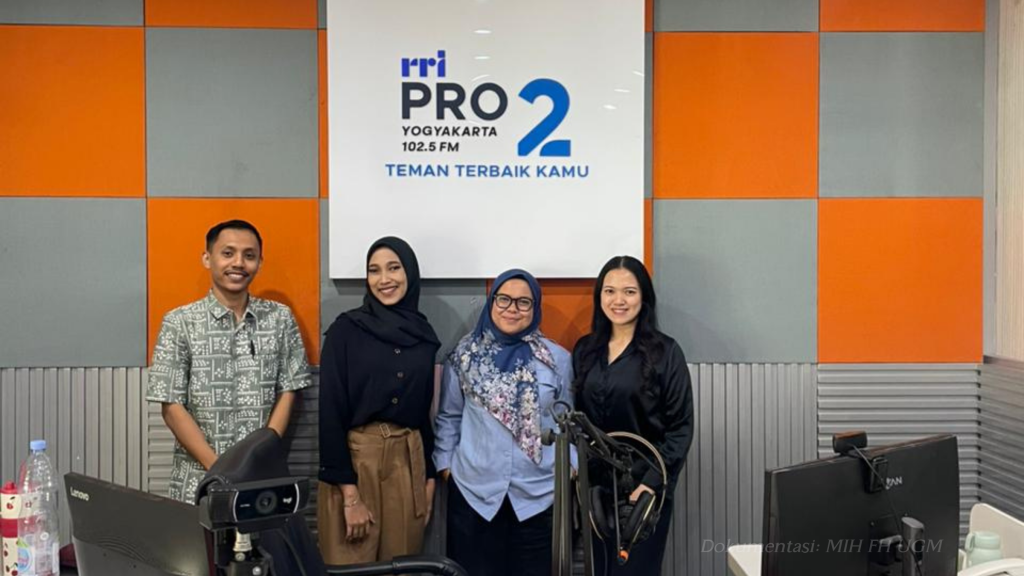
Amid the rapid development of information technology, the use of digital services has become an inseparable part of people's lives. Activities such as online shopping, using social media, accessing digital banking services, and utilizing various internet-based applications require people to provide their personal data to electronic system providers. However, this convenience is also accompanied by an increasing risk of personal data breaches and misuse that may cause harm to the public. In response to this situation, a team of students from the Faculty of Law, Universitas Gadjah Mada (FH UGM), conducted a legal education program through a radio broadcast on RRI PRO 2 Yogyakarta on Wednesday, June 17, 2026, at 12:00 PM WIB.
The activity featured an academic collaboration between Rivana Tesalonika Taroreh, S.H., a Master's student at UGM Faculty of Law, and Wildan Ulul Albab, S.H., M.H., a legal practitioner and advocate at KWA Lawyer in Yogyakarta. Hosted by radio announcer Grtricya Acha, the discussion raised a crucial topic entitled “Understanding the Public's Rights to Personal Data Protection in the Digital Era.” This activity was a realization of the Legal Education Grant Program organized by the Legal Consultation and Aid Center (PKBH) of FH UGM, in which Rivana Tesalonika Taroreh and her team member, Indri Jasinta, sought to provide inclusive legal education and create a direct impact on the wider community.
Through this activity, the public was provided with education regarding the concept of personal data, the forms of violations that frequently occur, and the legal protection mechanisms available under the applicable laws and regulations, particularly Law Number 27 of 2022 concerning Personal Data Protection. During the legal education session, Wildan Ulul Albab explained that personal data is information that can identify an individual, either directly or indirectly, such as names, identification numbers, addresses, telephone numbers, health data, and biometric data. Based on Law Number 27 of 2022 concerning Personal Data Protection, every individual has rights as a personal data subject, including the right to obtain information regarding the use of their data, the right to access and correct their personal data, the right to withdraw consent for data processing, and the right to request the deletion of personal data under certain circumstances. If these rights are violated, data subjects have the right to file complaints and seek accountability from the parties responsible for the violation.
Furthermore, Rivana Tesalonika Taroreh elaborated on various forms of personal data violations that are increasingly common in Indonesia, ranging from data breaches involving digital service customers, misuse of identities for online fraud, to the dissemination of personal information without the owner's consent. According to her, low levels of digital literacy and a lack of legal understanding often cause people to be unaware of the steps they can take when they become victims of personal data misuse. Therefore, this legal education program also discussed complaint mechanisms, dispute resolution procedures, and forms of liability that may be imposed on parties who violate the personal data rights of the public.
In addition to providing an understanding of legal aspects, this activity also equipped participants with practical measures to improve the security of personal data in the digital space. The public was encouraged to use strong passwords, enable two-factor authentication, change passwords regularly, limit the sharing of personal information with unknown parties, and be more careful in reading the terms and conditions of applications or digital services. Therefore, personal data protection does not solely depend on existing regulations but also on the awareness and vigilance of each individual in using digital technology.
This legal education activity has strong relevance to the Sustainable Development Goals (SDGs). First, it supports SDG 4 (Quality Education) because this activity provides legal education and digital literacy to the public in an inclusive manner. Second, it supports SDG 9 (Industry, Innovation and Infrastructure) by encouraging the creation of a safe and responsible digital ecosystem to support technological innovation. Third, it supports SDG 16 (Peace, Justice and Strong Institutions) by strengthening public awareness of legal rights, access to justice, and the importance of transparent and accountable data governance. Through this activity, it is expected that the public will better understand the importance of personal data protection as part of human rights and be able to actively participate in creating a digital environment that is safe, trustworthy, and just.
Penulis: Indri Jasinta (MIH FH UGM)