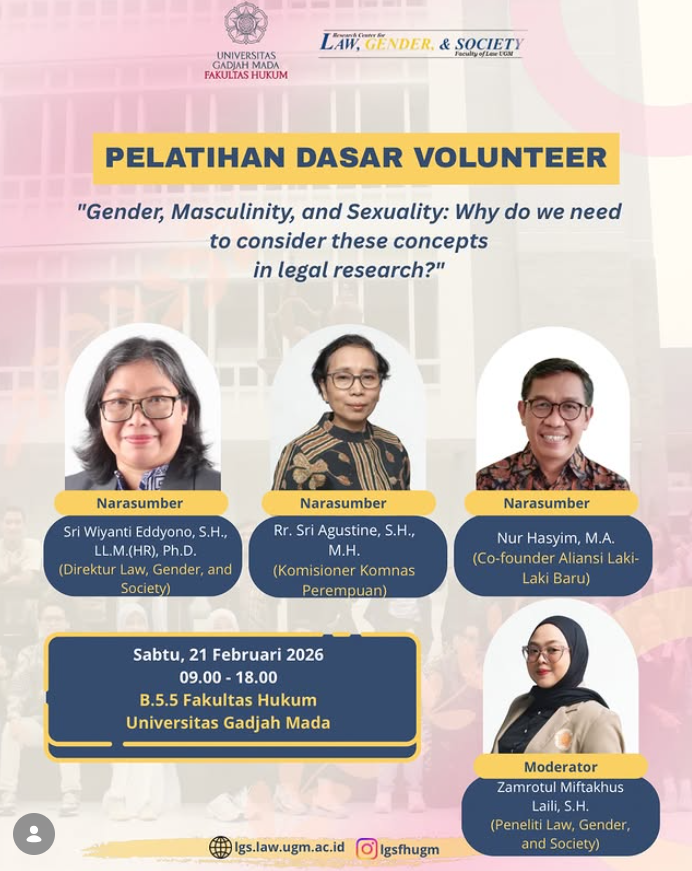
The Research Center for Law, Gender, and Society (LGS), Faculty of Law, Universitas Gadjah Mada, held a Basic Volunteer Training under the theme "Gender, Masculinity, and Sexuality: Why do we need to consider these concepts in legal research?" on Saturday, 21 February 2026, from 09.00 to 18.00 WIB, at Room B.5.5, Faculty of Law, Universitas Gadjah Mada. The training aimed to strengthen volunteers' understanding of gender, masculinity, and sexuality perspectives in legal research, while supporting the development of volunteer capacity in equality-based research and advocacy work.
The event featured three speakers: Sri Wiyanti Eddyono, S.H., LL.M (HR)., Ph.D., Director of Law, Gender, and Society; Rr. Sri Agustine, S.H., M.H., Commissioner of the National Commission on Violence Against Women (Komnas Perempuan); and Nur Hasyim, M.A., Co-founder of the New Men's Alliance (Aliansi Laki-Laki Baru). The session was moderated by Zamrotul Miftakhus Laili, S.H., Researcher at Law, Gender, and Society.
Through this training, the speakers discussed the concepts of gender, masculinity, and sexuality as important analytical frameworks in legal research, including how these concepts intersect and shape the way law perceives and treats different identity groups. The discussion also highlighted the role of men in the gender equality movement, national-level mechanisms for addressing gender-based violence, and the importance of building methodological sensitivity when researching issues related to identity and power relations.
This training forms part of LGS FH UGM's ongoing efforts to equip volunteers with a strong conceptual foundation as they engage in research, advocacy, and community service work grounded in a gender perspective.
The training also contributes to the achievement of the Sustainable Development Goals (SDGs), particularly SDG 4 on Quality Education by strengthening volunteers’ understanding of gender, masculinity, and sexuality as important perspectives in legal research; SDG 5 on Gender Equality by promoting equality, preventing gender-based violence, and encouraging men’s engagement in advancing gender equality; and SDG 16 on Peace, Justice, and Strong Institutions by fostering legal research and advocacy that are more responsive to issues of gender, identity, and power relations. Through capacity building, LGS FH UGM seeks to advance more inclusive, responsive, and equitable approaches to legal research and practice.