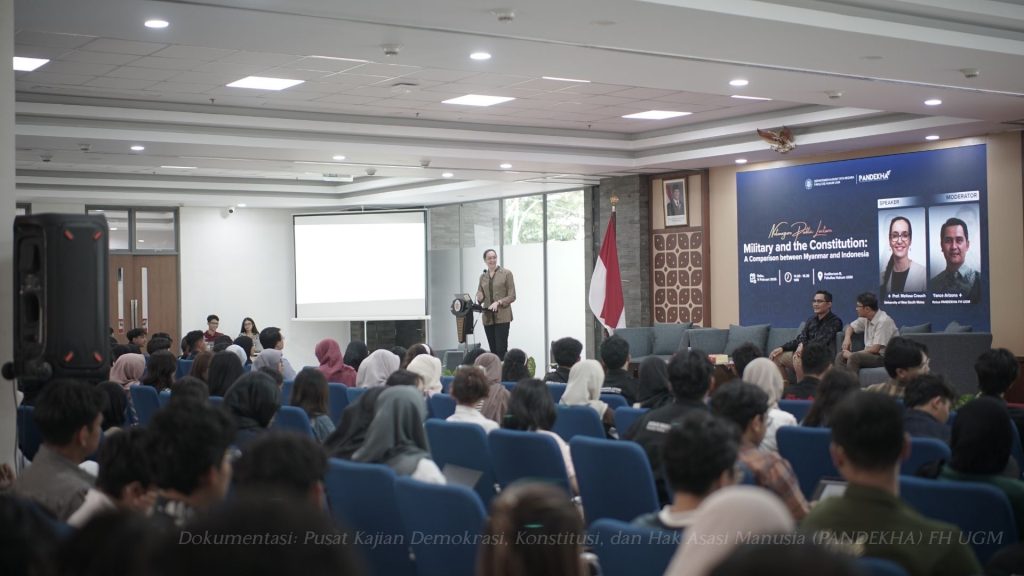
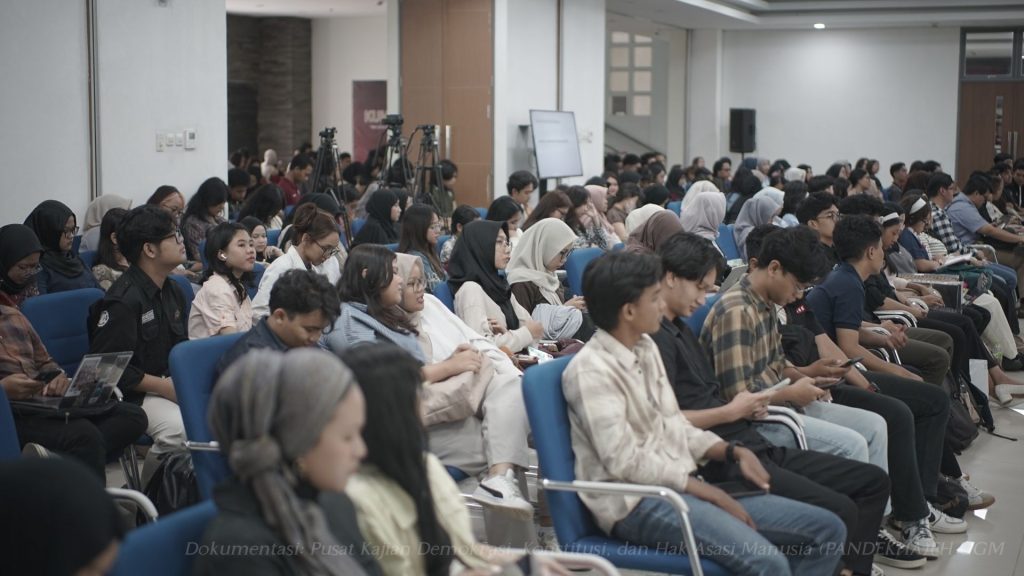
The Department of Constitutional Law and the Center for Democracy, Constitution, and Human Rights Studies (PANDEKHA) of the Faculty of Law, Universitas Gadjah Mada (FH UGM), held a Notonagoro Public Lecture entitled “Military and the Constitution: A Comparison between Myanmar and Indonesia.” The event was conducted in a hybrid format on Wednesday, 11 February 2026, taking place at the Auditorium of Building B, FH UGM, and streamed live via YouTube.
The public lecture was organized to examine the relationship between the military and constitutional governance in these two Southeast Asian countries, as well as its implications for democratic development. To explore this issue, the event featured Prof. Melissa Crouch from the University of New South Wales as the keynote speaker, with Dr. Yance Arizona serving as moderator. Prof. Crouch is a distinguished legal scholar whose research extensively focuses on the role of the military in shaping democracy and constitutionalism in Myanmar.
In her presentation, entitled “The Military and the Constitution: Comparative Reflections from Myanmar,” Prof. Crouch began by outlining the fundamental differences between Indonesia and Myanmar. Myanmar follows a common law legal tradition, similar to Australia, as a legacy of British colonial rule. Indonesia, by contrast, adheres to a civil law system inherited from the Dutch colonial period.
Prof. Crouch further explained that Myanmar’s transition toward civilian government began only in 2011, marked by the holding of general elections. This transition period lasted from 2011 until 2021. However, democratic progress was severely disrupted following the military coup in 2021. Available data indicate a significant increase in violence against civilians, including attacks and airstrikes, since the military takeover in February 2021.
She emphasized that understanding constitutional developments in Myanmar requires not only examining the country’s formal constitutional history but also considering what she referred to as “non-state constitutions”—alternative constitutional frameworks developed by civil society groups and pro-democracy actors. These alternative constitutional projects emerged largely because the existing constitutional framework continued to reflect the legacy of earlier constitutional arrangements influenced by colonial governance. Prof. Crouch described this phenomenon using the concept of a “palimpsest constitution,” whereby contemporary debates on constitutional reform remain deeply shaped by historical legacies. In Myanmar, the military continues to defend the 2008 Constitution, while pro-democracy actors challenge military rule through efforts to develop alternative constitutional visions. According to Prof. Crouch, one of the principal reasons many Myanmar citizens reject the 2008 Constitution is that it was drafted under military control. Consequently, protest movements have publicly burned copies of the constitutional text and demanded a democratic constitutional order.
In concluding her presentation, Prof. Crouch encouraged participants not merely to compare the situations in Myanmar and Indonesia. Rather, she urged them to pay closer attention to the realities faced by the people of Myanmar while also reflecting on the challenges and future prospects of democracy in Indonesia.
Forum diskusi publik ini diharapkan dapat memperkuat pemahaman tentang dinamika antara pengaruh militer dan praktik kehidupan bernegara yang konstitusional dalam mewujudkan negara yang demokratis. Hal ini selaras dengan Tujuan Pembangunan Berkelanjutan (SDGs); utamanya dengan SDG 16: Perdamaian, Keadilan dan Kelembagaan yang Tangguh. Adapun kolaborasi dengan Prof. Melissa Crouch yang merupakan akademisi dari lingkup Internasional merupakan bentuk pelaksanaan SDG 17: Partnership for the Goals, berkolaborasi bersama untuk menjawab permasalahan global.
Penulis: Lalu Aria Nata Kusuma (PANDEKHA FH UGM)